

When you have a brand-new baby, it can feel like you are supposed to be doing all the things.
Tummy time. High contrast cards. Baby music. Newborn sensory activities. Developmental activities. Tracking milestones. Buying toys.
But here’s the truth: newborns don’t actually need a packed schedule of sensory activities.
In fact, for an infant, everyday life is already full of sensory experiences. Being held, hearing your voice, feeling warm bath water, smelling your skin, watching light move across the room, and stretching on a blanket are all meaningful sensory moments.
So instead of thinking of newborn sensory activities as something extra you need to plan, it can be more helpful to notice the simple ways your baby is already learning through their senses.
- Get ready for the next phase with all the best toys for 4-month-olds!
In this post:
- Do Newborns Need Sensory Activities?
- What Are Newborn Sensory Activities?
- 20 Newborn Sensory Activities
- Signs Your Newborn May Be Overstimulated
- What Sensory Toys Do Newborns Need?
Do Newborns Need Sensory Activities?
Not in the way we often think of activities!
Newborns don’t need bins of sensory materials, complicated toys, or a list of things to “work on” every day. Their nervous systems are brand new, and the world is already a lot to take in.
For a newborn, sensory play is usually very simple. It might look like:
- Feeling your hand gently resting on their belly
- Hearing you talk while you change their diaper
- Looking at your face during feeding
- Feeling the difference between a soft blanket and your shirt
- Listening to normal household sounds
- Moving their arms and legs freely on the floor
These little moments may not look like “activities,” but they are exactly the kind of sensory input newborns are built for.
What Are Newborn Sensory Activities?
Newborn sensory activities are gentle experiences that help babies use their senses: sight, sound, touch, smell, taste, movement, and body awareness.
But again, these don’t need to be formal or Pinterest-worthy.
A newborn’s best sensory experiences usually come from:
- Connection with caregivers
- Slow, gentle movement
- Simple sounds
- Natural light
- Skin-to-skin contact
- Being carried
- Feeding
- Bathing
- Diaper changes
- Floor time
- Everyday routines
The goal is not to entertain your baby all day. The goal is to offer safe, loving, responsive care and let your baby experience the world in small, manageable ways.
21 Newborn Sensory Activities
1. Talking to Your Newborn
One of the simplest sensory activities for newborns is talking to them.
You don’t need to narrate every single second of the day, but your voice is one of your baby’s favorite sounds. They heard your voice before they were born, and it remains comforting and interesting after birth.
You can talk while you change their diaper, fold laundry, make coffee, or rock them.
This gives your newborn a gentle auditory experience while also helping build connection and early language exposure.
2. Singing Simple Songs
Singing is another beautiful newborn sensory activity, and it does not matter at all if you have a “good” singing voice.
Your baby does not care!
Soft songs, lullabies, humming, or even the same little made-up tune each day can be calming and familiar. Repetition is comforting for babies, so you do not need a huge playlist.
You can sing during diaper changes, feeding, bath time, or when your baby is fussy and needs help settling.
Bonus: singing also helps you regulate your nervous system so it can help you stay calm during fussy moments!
3. Looking at Your Face
Newborns are naturally drawn to faces, especially the faces of their caregivers.
Holding your baby close and letting them look at you is a rich sensory experience. They are noticing light, contrast, movement, expression, and connection all at once.
This can happen during feeding, cuddling, or quiet awake time.
You can smile, slowly move your head side to side, raise your eyebrows, or simply look back at them. It doesn’t need to be a performance. Your face is interesting enough.
4. Skin-to-Skin Time
Skin-to-skin is one of the most powerful sensory experiences for newborns!
Your baby feels your warmth, hears your heartbeat, smells your skin, and feels the rhythm of your breathing. It’s calming, regulating, and deeply connecting.
Either parent or caregiver can do this. You can place your baby on your bare chest with a blanket over both of you, making sure their airway is clear and they are safely positioned.
Skin-to-skin is not just for the first day or two after birth. It can continue to be a lovely sensory and bonding experience throughout the newborn stage.
5. Gentle Touch
Touch is one of the first ways babies experience the world.
You can offer gentle touch during ordinary care routines. A hand on their belly, a soft stroke on their back, or gently holding their feet during a diaper change all offer sensory input.
Some babies love infant massage, while others don’t. You don’t have to force it or turn it into a full routine. Simply pay attention to your baby’s cues.
If they seem relaxed, you can continue. If they turn away, tense up, cry, or seem overstimulated, pause and give them a break.
You can also offer gentle touch by stroking your baby’s arms and legs with an extra-soft hairbrush.
6. Diaper Changes
It may not seem like much, but diaper changes are full of sensory input.
Your baby feels the cool air, the wipe, your hands, the changing pad, their clothing moving on and off, and the position of their body as you gently lift and move them.
Instead of rushing every diaper change as a task to get through, you can occasionally slow down and make it a simple moment of connection.
Talk to your baby. Let them stretch for a minute. Gently bicycle their legs. Make eye contact if they are calm and alert.
It may not feel like a sensory “activity,” but it really is!
7. Feeding

Feeding is a huge sensory experience for newborns. It can be tempting to use this time to scroll on your phone, but feeding is such a powerful time for connection!
Whether your baby is breastfed, bottle-fed, or both, feeding includes taste, smell, touch, warmth, sucking, swallowing, body position, and connection.
Your baby may feel your arms around them, hear your voice, smell your skin, and look at your face.
You don’t need to add a thing to make” feeding “educational.” It already is.
8. Bath Time
Bath time is another natural sensory experience for newborns. A bathtub is just one giant, full-body sensory bin!
Your baby feels warm water, hears splashing, experiences the feel of a washcloth, and notices the change from dry to wet and back again.
Some babies don’t love baths. Some don’t.
If your baby enjoys bath time, you can slow down and let them feel the water on their feet or belly. If they hate it, keep it short and comforting. Sensory experiences should not be forced just because they seem like something babies are “supposed” to enjoy.
9. Floor Time
Newborns benefit from short periods of time on a safe, flat surface.
This might be on a blanket on the floor while you sit nearby. They can stretch, wiggle, turn their head, move their arms, and feel their body against the ground.
This is sensory input too.
Floor time gives babies a chance to experience movement and body awareness without being held, carried, or put in baby gear. It doesn’t have to last long, especially in the early weeks. Follow the lead of your baby.
Even a few minutes at a time can be plenty.
10. Tummy Time
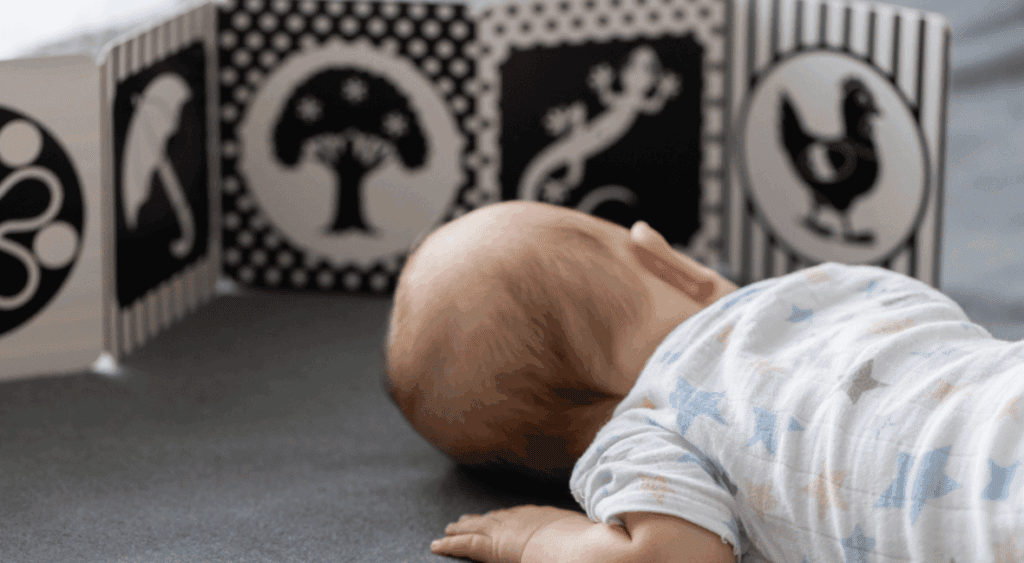
Tummy time is often talked about as a baby “activity,” but it can be very simple.
For a newborn, tummy time might happen on your chest, in a baby carrier, across your lap, or on a blanket for a short amount of time. It doesn’t need to be a long, formal session.
Tummy time helps babies experience pressure through the front of their body, practice lifting and turning their head, and build strength over time.
Some babies enjoy it. Some protest quickly. Start small and keep it gentle!
11. Looking at Light and Shadows
Newborns are still developing their vision, but they often enjoy looking at high-contrast objects.
You don’t need fancy visual toys. A window, soft natural light, shadows on the wall, or the outline of furniture can be interesting to a newborn.
You can hold your baby near a window, lay them on a blanket where they can see light and shadow, or let them watch the slow movement of a curtain.
Keep your baby in the shade and avoid placing them in direct bright sunlight.
12. High Contrast Images
High contrast books and image cards can be fun, but they are not required.
If you have black-and-white baby cards, you can place one nearby during awake time or tummy time. But your baby can also look at a dark picture frame on a light wall, the edge of a window, a striped blanket, or your face.
High contrast images are a great option. They aren’t something you need to do every day to “stimulate” your baby.
- Check out all my favorite high contrast books for infants!
13. Listening to Everyday Sounds
Your newborn doesn’t need constant baby music or special sound toys.
Everyday sounds are already part of their sensory world: running water, footsteps, dishes clinking, siblings talking, the dog walking by, birds outside, or the hum of the house.
Of course, newborns can become overstimulated by loud or constant noise, so this doesn’t mean creating more sound. It simply means noticing that your baby is already hearing and learning from normal family life.
14. Going Outside

Stepping outside with a newborn can be a wonderful sensory experience.
They may feel a breeze, hear birds, notice a change in light, or feel the temperature shift. Even a few minutes on the porch, in the yard, or on a short walk can offer new sensory input.
You don’t need to go anywhere exciting. A newborn does not need a big outing.
Bonus: being outside and moving can have a great impact on your mood too!
15. Being Carried
Being carried is full of sensory input.
Your baby feels movement, pressure, warmth, smell, sound, and the rhythm of your body. They experience changes in position and motion as you walk, sway, bend, and move through the day.
Whether you hold your baby in your arms or use a safe baby carrier, being close to you is both comforting and sensory-rich.
I absolutely love ring slings for the newborn days.
16. Gentle Rocking and Swaying
Newborns often find slow rhythmic movement calming.
Rocking in a chair, swaying side to side, or gently bouncing while holding your baby can provide vestibular input, which is related to balance and movement.
The key is gentle and responsive. Watch your baby’s cues. Some babies love movement, and others need very little. My baby LOVED being held and bounced on an exercise ball.
17. Smelling Familiar People
Smell is a powerful sense for newborns.
Your baby knows the smell of their caregivers. They may be comforted by your skin, your milk, or the familiar smell of your clothing.
This is another reason cuddling, feeding, and being held are not just “basic.” They’re rich sensory experiences.
You don’t need to add scented products. In fact, strong fragrances can be overwhelming for newborns. Familiar, natural smells are plenty.
18. Letting Baby Watch Everyday Life
Sometimes the best newborn sensory activity is simply letting your baby be near you while you do normal things.
They can lie on a blanket while you fold laundry, sit in a safe spot nearby while you eat, or play while you talk with another adult.
They’re seeing movement, hearing language, noticing light, and feeling the rhythm of daily life.
You don’t have to entertain them constantly. Being included in everyday life is meaningful.
19. Clothing and Texture Changes

Getting dressed, being swaddled, wearing a soft sleeper, feeling a blanket, or having socks put on and off all provide sensory input.
Newborns are experiencing textures all day long.
A cozy blanket, a cotton onesie, your shirt, a burp cloth, or a towel after bath time all offer touch experiences. You don’t need a basket of textured toys for this stage.
20. Quiet Time
Sensory development isn’t just about adding more stimulation. Newborns also need quiet.
Dim lights, a calm voice, a still room, or simply being held without extra noise can help babies regulate. Rest is important. Pauses are important. Looking away is important.
Sometimes the most supportive thing you can do is reduce sensory input.
21. Sock and Mitten Free Time
When the room is warm enough, let your newborn have some time without socks or mittens.
Babies get so much sensory input through their hands and feet as they stretch, wiggle, kick, and touch the world around them.
We want feet and hands out as often as possible when it’s safe and warm enough. Even a few minutes during diaper changes, floor time, or cuddles gives babies a chance to feel the air, your skin, their blanket, and their own movement.
Signs Your Newborn May Be Overstimulated
Because newborns are taking in so much, they can become overstimulated quickly.
Signs may include:
- Turning their head away
- Crying
- Arching their back
- Hiccuping
- Sneezing repeatedly
- Looking frantic or wide-eyed
- Clenching fists
- Becoming fussy after being passed around or played with
- Difficulty settling
If your baby seems overstimulated, you do not need to push through. Try lowering the lights, reducing noise, holding them close, swaddling if appropriate, or giving them a break.
Sensory activities should support your baby, not overwhelm them.
What Sensory Toys Do Newborns Need?
Honestly, not many.
A newborn does not need a room full of toys. If you want a few simple things, you might use:
- A soft blanket
- A few high-contrast cards
- A baby-safe mirror for supervised floor time
- A play mat or blanket for floor time
But your f”ce, voice,”arms, and everyday routines are still the most important “materials.”
It is completely okay to keep this stage simple.
Findon’toughts on Newborn Sensory Activities
Newborn sensory activities don’t have to be activities at all.
Your baby is already learning through every cuddle, feeding, diaper change, bath, walk, and quiet moment with you. They are feeling, smelling, hearing, seeing, moving, and connecting all day long.
So instead of feeling pressured to do more, you can notice what is already happening.
Your newborn doesn’t need constant entertainment. They need care, connection, rest, and small moments of gentle sensory experience woven into everyday life.




No Comments