
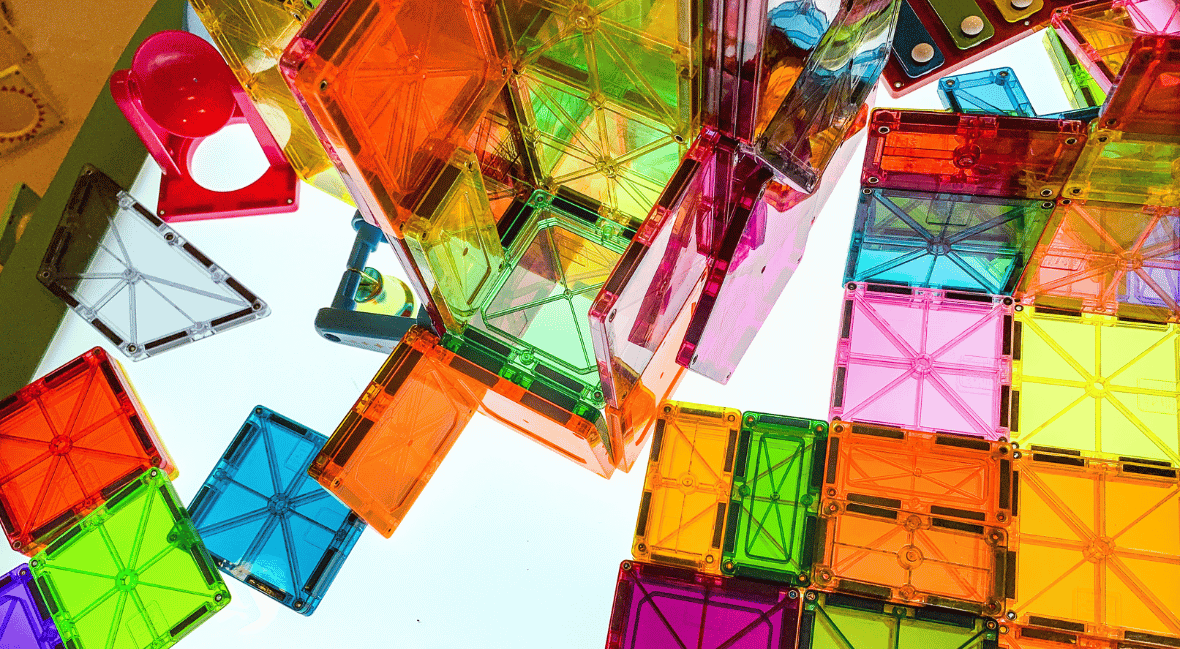
Kids are natural problem solvers. They test, experiment, stack, build, knock things down, try again, and adjust their ideas as they play. The best toys for building problem-solving skills are usually the ones that give kids room to think, create, test, and figure things out on their own.
I love both open-ended toys and skill-based toys like logic games or puzzles. Open-ended toys are flexible and can be used in many different ways, while logic games offer a clear challenge to work through. Even though they look different, both types can still be child-directed. Many logic games are self-correcting, which allows children to try, make mistakes, and try again on their own.
Below are some of the best toys for building problem-solving skills, divided into baby and toddler toys, building toys, games, and open-ended toys.
In this post:
- Baby and Toddler Toys for Building Problem-Solving Skills
- Building Toys for Problem Solving
- Games That Build Problem-Solving Skills
- Open-Ended Toys for Problem Solving
- Everyday Items That Build Problem-Solving Skills
- Time Is the Key to Building Problem-Solving Skills
We get commissions for purchases made through links in this post. As an Amazon Associate, we earn from qualifying purchases.
Baby and Toddler Toys for Building Problem-Solving Skills
Baby and toddler toys build problem-solving skills through simple, hands-on exploration. At this age, kids are figuring out how the world works. What happens if I drop this? Which cup fits inside this one? How do I turn this piece so it fits?
The best baby and toddler problem-solving toys usually support cause-and-effect, object permanence, early spatial reasoning, hand-eye coordination, and trial and error. They may look simple, but this kind of play lays the foundation for more complex problem-solving later.
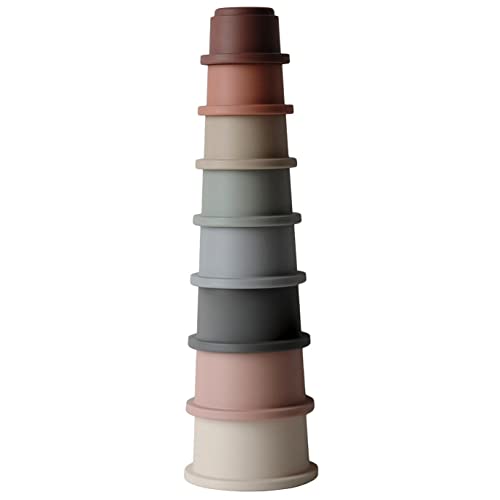
1. Stacking Cups
Best for ages: 6 months to 3 years
Stacking cups are simple, affordable, and full of problem-solving opportunities. Babies and toddlers can nest them, stack them, knock them over, hide objects underneath them, scoop with them, and use them in water play.
Kids explore size, order, balance, cause and effect, and early spatial reasoning. They begin to figure out which cups fit together and how to build a tower that does not fall right away.
2. Object Permanence Box

Best for ages: 6 months to 18 months
An object permanence box is great for babies who love putting things in and taking them out. Dropping a ball into a hole and watching it come out again helps babies understand cause and effect.
This kind of toy also supports hand-eye coordination, tracking, and early problem-solving. Babies begin to realize that their actions make something happen.
3. Nesting Blocks

Best for ages: 6 months to 3 years
Nesting cups, nesting boxes, or nesting blocks help babies and toddlers experiment with size and order. They have to figure out what fits inside what, which pieces are too big, and how to stack or arrange them.
These toys may look simple, but they support early math thinking, spatial awareness, and trial-and-error learning.
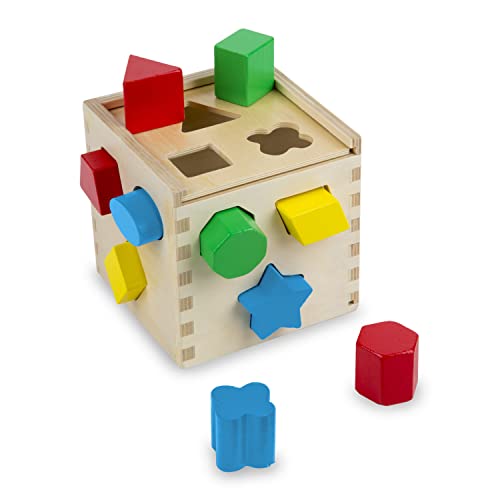
4. Shape Sorter
Best for ages: 12 months to 3 years
A shape sorter helps young kids notice differences in shape, size, and space. They have to turn the piece, test different openings, and keep trying until it fits.
This is a wonderful toy for building problem-solving skills because it encourages persistence. It also helps toddlers practice visual discrimination, hand-eye coordination, and spatial reasoning.
5. Chunky Puzzles

Best for ages: 18 months to 4 years
Chunky puzzles are great for toddlers and young preschoolers. Kids have to match shapes, rotate pieces, and figure out how each piece fits into the space.
Puzzles build visual problem-solving, patience, fine motor skills, and persistence. Simple puzzles are a great starting point before moving into more complex jigsaw puzzles later.
6. Ball Runs

Best for ages: 18 months to 2 years
Ball runs are wonderful for young kids because they invite experimentation. Kids can place the ball at the top, watch where it goes, and begin to understand direction, speed, gravity, and cause and effect.
Some ball runs are simple and toddler-friendly, while others allow preschoolers to rearrange pieces and create their own paths. Either way, they encourage kids to test ideas and notice what happens.
Building Toys for Problem Solving
Building toys are among the best for developing problem-solving skills because they naturally ask kids to plan, test, adjust, and try again! And some of just the best toys overall, in my humble opinion.
Every structure comes with little challenges. How can I make this taller? Why did it fall? How do I connect these pieces? What would make this stronger?
These toys support spatial reasoning, engineering thinking, persistence, creativity, and flexible problem solving. They are also wonderful because many building toys grow with kids. A toddler may simply stack, while an older child may design bridges, towers, marble runs, machines, and detailed pretend play worlds.
7. GuideCraft Unit Blocks

Best for ages: 2 to 8+ years
If I had to choose one toy for problem-solving, it would probably be unit blocks!
Unit blocks are carefully sized so kids can build with balance, symmetry, measurement, and structure in mind.
I’ve had many sets of unit blocks over the years, and the ones from Guidecraft are my favorite. They’re super precise and high quality, which makes a big difference when building.
Preschoolers and older kids use blocks to plan, build, test, rebuild, and create. They learn about height, weight, stability, ramps, bridges, enclosures, and design through play.
Yes, unit blocks are expensive, but they’re one of those toys kids can return to again and again for YEARS.
- Check out more of my favorite block sets!
8. MagnaTiles

Best for ages: 3 to 8+ years
MagnaTiles are AMAZING for spatial reasoning and creative problem solving. Kids can build flat designs, 3D structures, houses, castles, garages, ramps, and more.
When choosing magnetic tiles, it’s worth going with a high-quality brand like Magna-Tiles rather than cheaper versions. They really are more durable, last longer, and are safer. Lower-quality tiles can crack over time, allowing the magnets to fall out, something you definitely want to avoid!
Kids quickly learn what holds together, what collapses, and how to change their design. MagnaTiles are also great for independent play because kids can build, test, and adjust without much adult help.
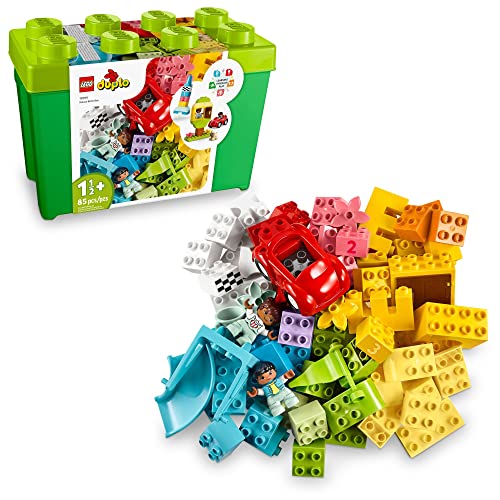
9. LEGO DUPLOs
Best for ages: 18 months to 5 years
LEGO DUPLO one of my favorite beginner building bricks for kids! They’re perfect for toddlers and preschoolers who are ready to connect pieces and build with more intention. They can create towers, houses, vehicles, animals, and pretend play scenes.
DUPLO supports planning, sequencing, spatial reasoning, and flexible thinking. It is also a great bridge between simple blocks and smaller LEGO bricks.
Make sure to get a large set, so there are enough bricks for kids to actually build something.
10. LEGOs

Best for ages: 4 to 10+ years
Okay, who doesn’t love LEGOS?!
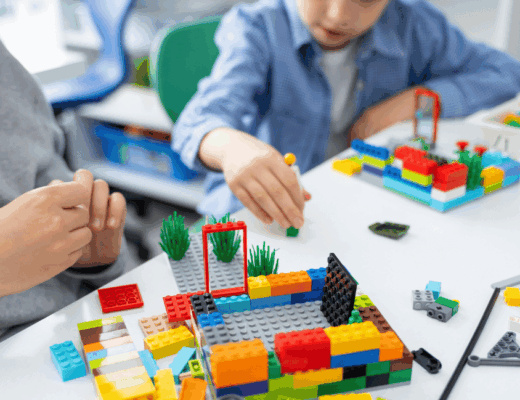
LEGO sets are great for older preschoolers and big kids who are ready for smaller pieces and more detailed building. Open-ended LEGO sets give kids the chance to design, build, revise, and create from their own ideas.
Kids can follow instructions or build freely, and both types of play support problem-solving. Following directions builds sequencing and attention to detail, while free building supports creativity and design thinking.
11. Tinkertoys

Best for ages: 3 to 8 years
Anyone else grow up playing with Tinkertoys?! 🙋♀️
Tinkertoys are a classic construction toy that let kids build with rods, spools, and connectors. They can make towers, vehicles, animals, shapes, and all kinds of creative structures.
They support problem-solving because kids have to figure out how to connect pieces, balance their builds, and adjust when something does not work.
12. Guidecraft Notch Blocks

Best for ages: 3 to 8+ years
Guidecraft Notch Blocks are one of my favorite building toys because kids are so drawn to them! The oversized wooden pieces notch together, allowing kids to build big structures that feel sturdy, satisfying, and often large enough for them to play inside.
These blocks are wonderful for problem-solving because kids have to think about balance, connection, height, and structure as they build houses, caves, buses, etc., for their dramatic play. I’ve seen kids use them in some truly creative ways.
They’re expensive, but they are such a beautiful, open-ended building material.
13. Marble Run

Best for ages: 4 to 10+ years
A marble run is one of the best toys for building problem-solving skills because kids have to think through how pieces connect and where the marble will go. They test a design, notice what works, and change what does not.
They’re such a fun building toy that all kids seem to love, and their open-ended nature makes them feel new and exciting each time kids build with them.
Marble runs encourage planning, patience, cause-and-effect, and early engineering thinking. They are especially great for kids who like building and experimenting.
14. K’NEX

Best for ages: 5 to 10+ years
K’NEX are great for kids who are ready for more complex construction. If you’re a sucker for varied building toys, this one is super fun and feels different from traditional blocks. Kids use rods and connectors to build structures, vehicles, and moving designs.
This type of building toy encourages planning, spatial reasoning, engineering thinking, and persistence, all while being fun. Kids get to test how pieces connect and how to make their ideas more stable or functional.
15. Snap Circuits

Best for ages: 8 to 12+ years
While not a true building toy, Snap Circuits are great for older kids who are curious about how things work. Kids follow diagrams to create working circuits with lights, sounds, fans, switches, and more.
This toy builds problem-solving skills through sequencing, troubleshooting, and cause-and-effect. If something doesn’t work, kids have to check the circuit and figure out what needs to change. I love the self-correcting nature of the materials.
Games That Build Problem-Solving Skills
Games are a great way to build problem-solving skills because they often add a clear challenge.
Single-player logic games are especially helpful for building persistence and independent problem-solving. Strategy games like chess help kids think through choices and consequences. The best part is that games can make problem-solving feel fun instead of forced.
I absolutely love games, and it was so hard to narrow this section down (you might notice my love of SmartGames)! But here are SOME of my favorites.
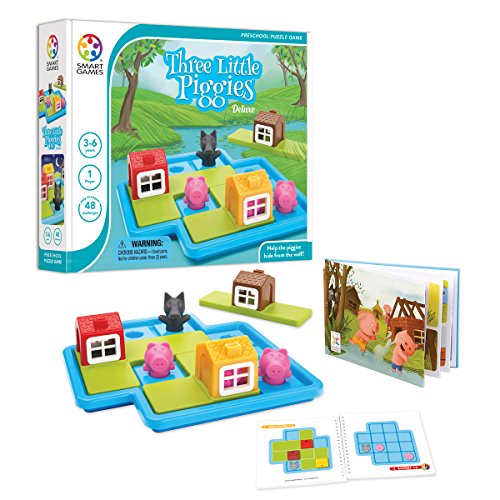
16. SmartGames Three Little Piggies Deluxe
Best for ages: 3 to 6 years
SmartGames Three Little Piggies Deluxe is a great first logic game for preschoolers. This was my first intro to SmartGames, and I LOVE it!
Kids place the pigs, houses, and wolf on the game board based on each challenge. It only needs one kid to play. They just look at the challenge card and move the pieces around until they solve it. It’s super hands-on, and multiple kids or kids and adults can also work together.
It supports spatial reasoning, planning, and flexible thinking. I also love that it connects to a story many kids already know, which makes the puzzle feel more like play than a worksheet-style activity.
17. SmartGames Trucky 3

Best for ages: 3 to 6 years
SmartGames Trucky 3 is a really fun problem-solving game for kids who love vehicles!
The bright, chunky trucks and colorful cargo pieces make it feel more like playtime than a puzzle, which kids love. Kids get to load up the trucks by fitting the cargo pieces just right so everything fits perfectly.
It builds spatial reasoning, visual planning, and persistence in a hands-on, engaging way. Kids quickly learn that pieces may need to be turned, moved, or tried in a different order before everything fits, and it’s so satisfying when they finally get it right.
- Check out more fun toys for kids who love cars!
18. Cubetto

Best for ages: 3 to 6 years
Cubetto is a screen-free coding toy that is especially nice for younger kids. Kids use physical coding blocks to guide the wooden robot along a path.
It supports sequencing, directionality, planning, and problem-solving in a hands-on way. I love that it gives kids immediate feedback: they try something and see what happens, which makes it super fun and engaging.
19. SmartGames Little Red Riding Hood Deluxe

Best for ages: 4 to 7 years
SmartGames Little Red Riding Hood Deluxe is a logic puzzle game where kids build a path for Little Red Riding Hood to reach Grandma’s house. It feels playful and story-based, but it’s also a great introduction to planning and step-by-step thinking.
Kids have to look at the challenge, think through possible paths, and adjust when their first idea does not work. It’s a nice problem-solving toy for kids who like puzzles but still enjoy a little pretend play mixed in.
20. Kanoodle Jr.

Best for ages: 4 to 7 years
Here is another fun game for young kids!
Kanoodle Jr. is a hands-on brain-teaser puzzle that challenges kids to fit colorful pieces into various designs. It’s great for visual problem-solving and spatial reasoning.
Kids have to rotate pieces, try different placements, and keep going when their first attempt does not work. It’s also small and easy to take on the go.
21. Rush Hour Jr.

Best for ages: 5 to 8 years
Rush Hour Jr. is a classic logic game where kids slide cars and trucks around the board to help the ice cream truck escape from a traffic jam. The playful story element makes it especially engaging, as kids feel like they are solving a real problem to save the day.
Kids have to plan ahead, move pieces in the right order, and think through different possibilities. It’s one of those games that quietly builds persistence because each puzzle feels like a fun challenge.
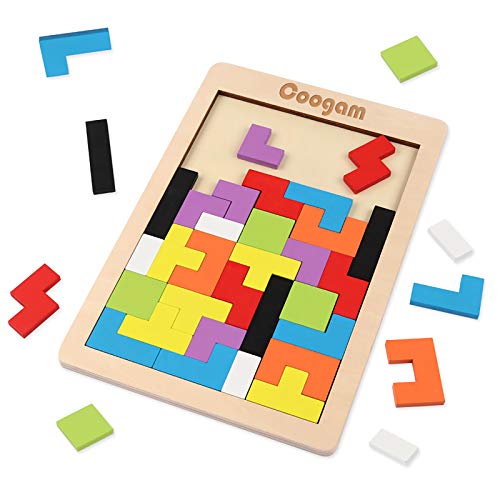
22. Coogam Puzzle Brain Teaser
Best for ages: 4 to 8+ years
This Coogam wooden blocks puzzle is a colorful tangram-style brain teaser that feels like a screen-free version of Tetris!
Kids fit different-shaped pieces into the board or use them to create different pictures and designs. It’s a nice hands-on puzzle for kids who like shape challenges but may not be ready for more complicated logic games yet.
This type of brain teaser helps build spatial reasoning, visual planning, patience, and flexible thinking. Kids have to rotate pieces, test different arrangements, and keep trying until the design works.
23. SmartGames Smart Farmer

Best for ages: 5 to 8 years
SmartGames Smart Farmer is a fun logic game where kids help separate the animals by placing fences in just the right spots. It’s a great pick for kids who are ready for a little more of a challenge but still want something playful and hands-on.
As they play, kids naturally build planning skills, spatial reasoning, and problem-solving because they have to think ahead and try out different fence arrangements. It’s easy to set up, but the puzzles are engaging enough to keep them coming back for more.
24. Botley

Best for ages: 5 to 8 years
Botley is another screen-free coding robot that my kids come back to again and again. They love programming him to move, turn, and complete little missions around the room, and it quickly turns into a fun challenge to see what they can get him to do next.
I really like that it introduces coding concepts without needing a tablet or computer. My kids end up planning out their steps, testing their ideas, and then laughing (and trying again) when Botley doesn’t go where they expected.
It’s a fun example of learning through play.
25. Rubik’s Puzzle Ball

Best for ages: 5 to 10+ years
This Rubik’s puzzle ball adds a fun twist to classic brain teasers by combining a spherical design with sliding and matching challenges.
Kids move the colored balls through the maze-like tracks, working to get each piece into the correct spot. It’s a great hands-on puzzle for kids who enjoy fidget-style toys but also want a challenge.
As they play, kids build problem-solving skills, hand-eye coordination, patience, and persistence as they figure out the right sequence of moves to complete the puzzle.
I’ll admit, I enjoy playing with this one too. It’s surprisingly satisfying and just challenging enough to keep me coming back for another try.
26. Chess

Best for ages: 5 to 10+ years
I love playing chess with kids, and there are so many fun ways to introduce it, from story-based sets like Story Chess to high-tech electronic boards that guide beginners.
Chess is one of the best games for building problem-solving skills because kids have to think ahead, make a plan, and adjust based on what the other player does.
Kids do not need to become serious chess players to benefit from it. Even learning how the pieces move, playing simplified games, and practicing basic strategy can support logic, patience, memory, and flexible thinking.
- Check out all my favorite chess sets for kids!
27. SmartGames Anti-Virus

Best for ages: 7 to 10+ years
SmartGames Anti-Virus is a sliding puzzle game in which kids move pieces around the board to remove the red virus piece. It requires planning, strategy, and flexible thinking.
This is a super fun SmartGames choice as kids get a bit older. It can be played solo with the challenge cards, but it also works well as a collaborative puzzle for kids to solve together.
28. SmartGames Pirates Crossfire

Best for ages: 7 to 10+ years
SmartGames Pirates Crossfire is a logic game where kids use challenge cards to place ships and solve each puzzle, just like many of the other SmartGames in this section (which is why I love them). It’s another great variation on that same idea of working through structured challenges, but with a fun pirate story layered on top.
Kids have to slow down, look carefully, and think through where each piece belongs. It is a great fit for kids who like puzzles with a little adventure theme.
29. SmartGames IQ Gears

Best for ages: 7 to 10+ years
Oh, and look, another SmartGames pick! I just couldn’t resist.
SmartGames IQ Gears is a compact logic puzzle that challenges kids to place gears so everything connects correctly. It is great for kids who enjoy hands-on problem-solving and mechanical thinking.
Kids love the small size, and it’s fun to play alone or together with others. It’s easy to take on the go, making it a great travel game.
This toy supports spatial reasoning, planning, and cause-and-effect thinking.
Open-Ended Toys for Problem Solving
Open-ended toys are among my favorite tools for building problem-solving skills because there is no single “right” way to use them. Kids have to come up with their own ideas, make choices, test materials, and figure out what works.
These toys support creative problem solving, flexible thinking, imagination, planning, and independence. They also tend to grow with kids because the play becomes more complex as the child’s ideas become more complex.
Here are some more open-ended toys in addition to the building toys listed above.
30. Sarah’s Silks

Best for ages: 1 to 8 years
Play silks may not look like a problem-solving toy at first, but they’re incredibly open-ended. Kids use them as capes, blankets, rivers, forts, costumes, picnic mats, baby beds, or pretend food.
This kind of flexible thinking is a huge part of problem-solving. Open-ended materials help Kids think creatively and see many possibilities in one simple toy.
I absolutely love Sarah’s silks for their high quality and the fun variety of colors and sizes.
31. Makedo Cardboard Construction Tools

Best for ages: 4 to 10+ years
This set of cardboard building tools is one I genuinely love. It is super fun to build with and perfect for kids who like to plan, try something out, tinker, and then try again.
The kit includes child-safe cardboard cutters, screws, and connectors that let kids turn recycled boxes into forts, robots, vehicles, ramps, and all kinds of imaginative creations. The tools cut better than you might expect, making it easier for kids to follow through on their ideas without getting frustrated.
It’s a great hands-on way to build problem-solving skills because kids have to figure out how to connect pieces, make structures stable, adjust when something does not work, and keep experimenting until it does.
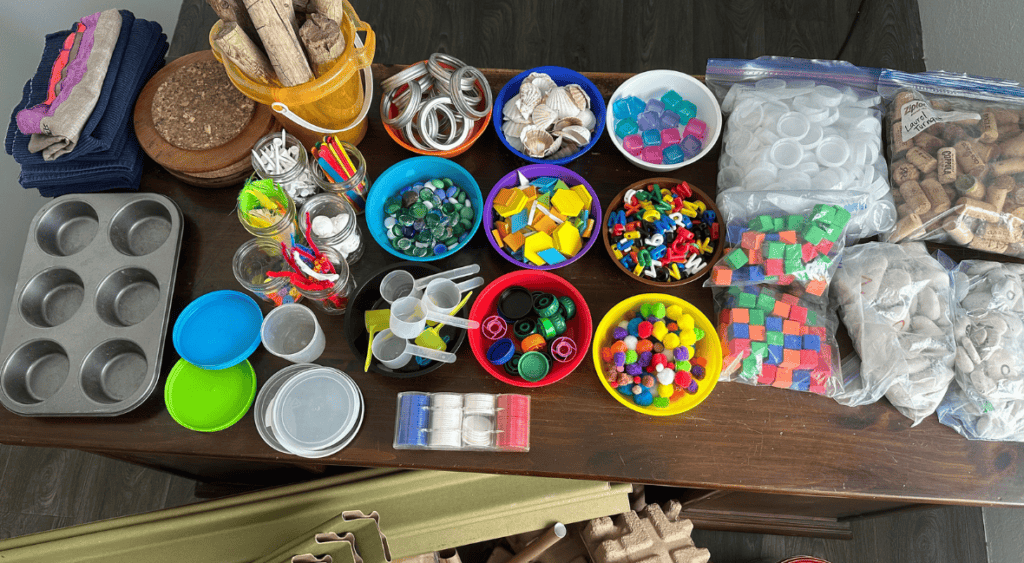
32. Loose Parts
Best for ages: 2 to 8+ years
Loose parts are another great toy for building problem-solving skills!
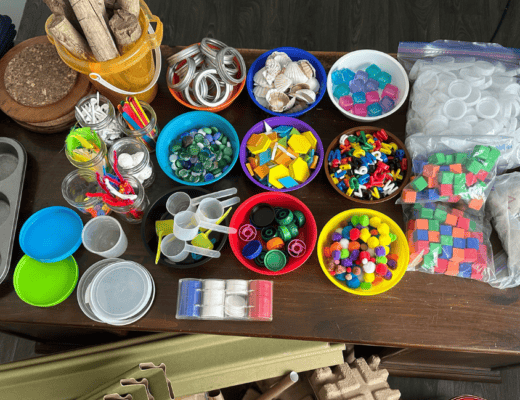
Essentially, loose parts are any child-safe object. These can be things like rocks, sticks, shells, wooden rings, fabric pieces, lids, pinecones, tubes, corks, gems, or small containers.
Kids can sort, stack, arrange, build, pretend, pattern, design, and create with loose parts. Because there is no single correct way to use them, kids have to come up with their own ideas and solve their own play problems.
Everyday Items That Build Problem-Solving Skills
While toys are great, kids will play with just about anything! Don’t feel like you need to rush out and buy a bunch of stuff to foster development. Kids build problem-solving skills through everyday play and exploration, too.
Some of the best materials are things you may already have at home:
- Cardboard boxes
- Paper towel tubes
- Scarves or fabric scraps
- Plastic containers and lids
- Measuring cups
- Rocks, sticks, and pinecones
- Painter’s tape
- Pillows and couch cushions
- Paper, scissors, and glue
- Recycled containers
These simple materials invite Kids to think creatively, test ideas, and figure things out on their own.
Time Is the Key to Building Problem-Solving Skills
As much as I love a good problem-solving toy, the real key is not just having more toys. Kids need lots of time to play.
Problem-solving happens when kids have enough time to get deep into their play, make a plan, run into a problem, get frustrated, try something different, and keep going. If play is always rushed or overly directed, kids don’t get as many chances to work through those little challenges on their own.
This is one of the reasons I love open-ended play so much. A child building with blocks might spend twenty minutes just trying to make a roof stay up. Another child might use loose parts to create a pretend bakery, then realize they need a way to make money, organize orders, or build a counter. These little play problems are where so much thinking happens.
So yes, the right toys can absolutely help. Blocks, puzzles, logic games, magnetic tiles, cardboard tools, and loose parts can all support problem-solving skills. But kids also need time, space, and permission to use them in their own way.
Remember: building new skills takes time and practice!
Final Thoughts on the Best Toys for Building Problem-Solving Skills
The best toys for building problem-solving skills are usually the toys that give kids room to explore, test ideas, make mistakes, and try again.
Stacking cups, blocks, magnetic tiles, logic games, building tools, loose parts, coding toys, and classic games like chess all give kids a chance to think deeply through play. When kids are given time, space, and simple materials, problem-solving happens naturally.
Play is full of little problems to solve: How can I make this tower taller? Why did that fall? How do I connect these pieces? What else could this become?
That is where the real learning happens.

No Comments